設計發浪!日本設計名人案內所 ( design surfing / デザインサーフィン ) 日本デザインのコアや魅力などのをこのブログを拠点とし、台湾のあちこちに発信しにいきます。


ON SITE|Admira Gallery at Frieze Seoul 2026

Frieze Seoul 2026 has officially opened. Making its debut at Frieze Seoul, Admira Gallery presents “Light Painting × Light Sculpture,” a curatorial dialogue between Japanese contemporary artists Tomoya Tsukamoto and Atsuro Miyako, as part of Material Practice, curated by Korean independent curator Hyeyoung Cho.
From the pigments and colors of traditional painting to polarizing materials, transparent media, and LEDs; from two-dimensional paintings to luminous sculptural works, the presentation takes “light”—a shared concern in both artists’ practices—as its point of departure. It brings together two distinct artistic languages shaped by different generations, material systems, and creative backgrounds.
As the works enter the physical space of Frieze Seoul, however, the dialogue between them takes on another dimension, transforming through the exhibition space into an embodied experience of viewing.
Painting Moves into Space, Sculpture Leaps onto the Wall
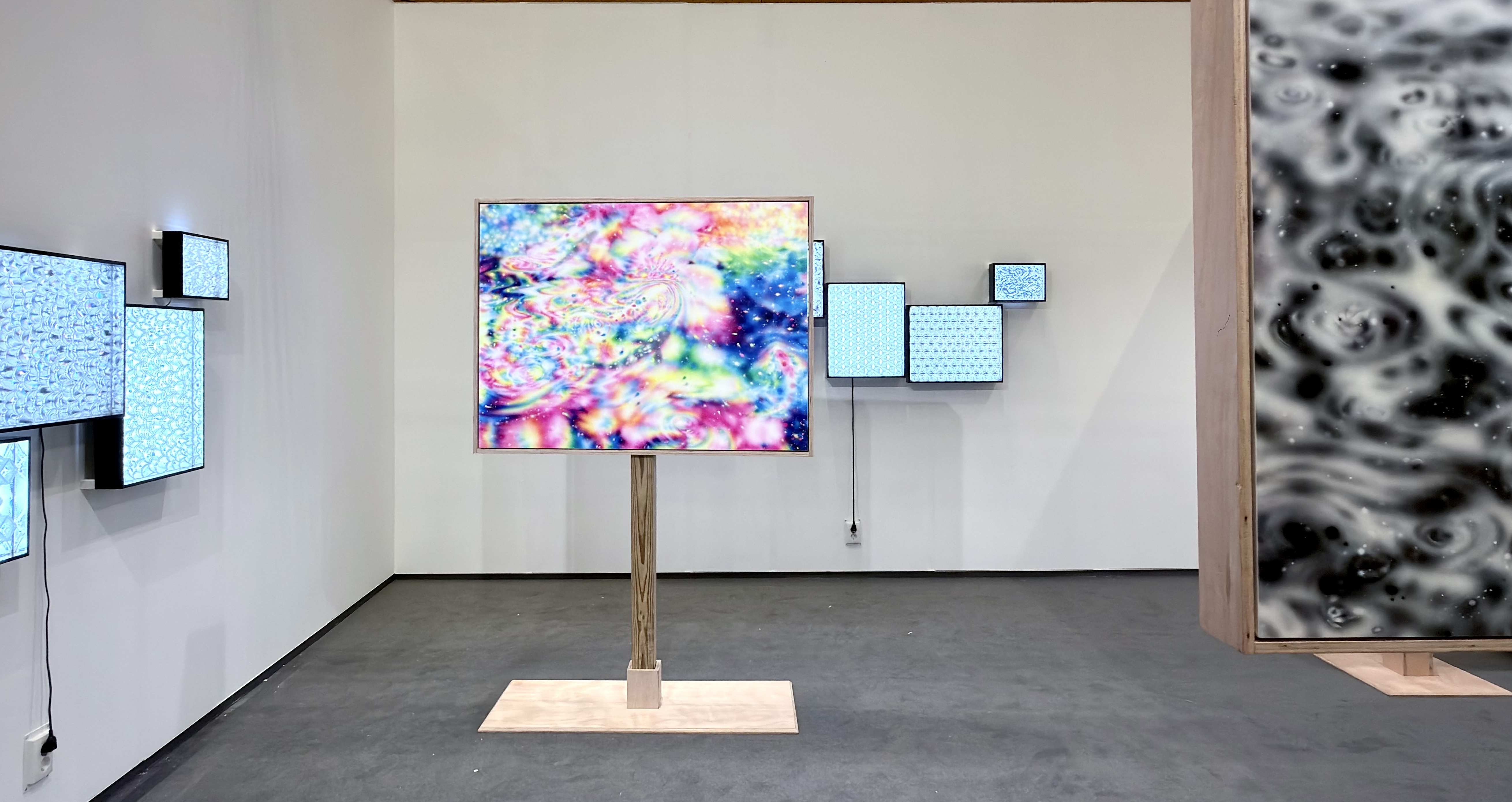
Rather than separating the two artists according to conventional categories of medium, Admira Gallery intersperses their works throughout the same space. Tsukamoto’s paintings leave the wall and move into the center of the booth on freestanding structures, while Miyako’s works—constructed through light, polarization, and material—leap onto the walls like clusters of luminous images. As the boundaries between media begin to loosen, familiar modes of viewing are also displaced.

The viewer is therefore no longer limited to encountering each work frontally. Moving through the space, the works continually become foreground and background to one another. Tsukamoto’s vivid primary colors and near-achromatic blacks repeatedly overlap, from different distances and perspectives, with the cool light produced through Miyako’s materials and polarization. The relationship between the works no longer exists solely as a curatorial proposition; it continually unfolds through the viewer’s own movement and act of looking.
From Traditional Pigments to Industrial and Optical Materials
This dialogue is equally present in the artists’ radically different choices of material.Tsukamoto begins with the most fundamental materials of painting—pigment and color. By separating, mixing, and repeatedly layering the three primary colors of red, blue, and yellow, he uses optical mixing and viewing distance to allow color to generate sensations of light, shadow, and space.
Miyako begins from an entirely different material system. Working with polarizing materials, transparent media, LEDs, and other materials associated with industrial and technological processes, he draws upon their physical properties to transform phenomena that cannot ordinarily be perceived directly by the naked eye into visible light and color.
On one side, color is generated through pigment; on the other, through material and light. One begins with the history of painting, while the other approaches art through industry, technology, and natural physical phenomena. Yet these seemingly opposing trajectories gradually converge within the exhibition space.
Tsukamoto uses traditional painting materials to create a visual sensation akin to light; Miyako uses industrial and optical materials to produce colors, textures, and planar compositions that evoke painting. As painting acquires a spatial dimension and sculpture takes on painterly qualities, the boundaries traditionally used to distinguish between media begin to dissolve.
This reveals another dimension of Material Practice within the presentation: material is no longer merely a means of making an artwork, but a point of departure for reconsidering how we see.
From Visible Color to Invisible Black

Tsukamoto’s Swimming in the universe, presented at Frieze Seoul, takes this dialogue around “light” toward its apparent opposite: “black.”Unlike his earlier approach of spraying and layering the three primary colors separately to create color through optical mixing, in Swimming in the universe Tsukamoto pre-mixes equal amounts of red, blue, and yellow, using the resulting “black” to depict koi swimming through water.
The black is not produced with black pigment. The vivid primary colors remain present within it, but through their combination they are transformed into a state of color that “exists, yet cannot be seen.” The resulting layers of black evoke the tonal depth of East Asian ink painting, allowing Tsukamoto’s longstanding engagement with Eastern and Western histories of painting to converge within a single work.
This creates another compelling dialogue with Miyako’s practice. Through polarization and the physical properties of materials, Miyako transforms forces that exist but cannot ordinarily be perceived by the naked eye into visible light and color.
Tomoya Tsukamoto conceals color within the flow of black,while Atsuro Miyako reveals patterns hidden within white light.One moves from the visible toward the invisible, while the other moves from the invisible toward the visible. Two trajectories moving in opposite directions ultimately converge within the same space.
“Light Painting × Light Sculpture”: Reopening the Ways We See Art
“When we first conceived ‘Light Painting × Light Sculpture,’ we began with the presence of ‘light’ shared by both artists’ practices,” says Admira Gallery General Manager Chad Liu. “But once the works actually entered the space of Frieze Seoul, I found something even more interesting in the shift between two different approaches to material and ways of seeing. Traditional pigments and industrial and optical materials begin to reflect and respond to one another within the same space.”

He continues: “We did not want simply to place the works of two artists side by side. Instead, we wanted viewers to continually reconstruct the relationships between them as they move through the exhibition. When painting begins to acquire the spatial qualities of sculpture, and sculpture begins to reveal painterly color and composition, the categories we are accustomed to using to understand art may also begin to loosen.”
For Admira Gallery, painting, sculpture, craft, design, and technology are not separate destinations, but different points of departure through which artists can construct the language of contemporary art. Through its participation in Material Practice at Frieze Seoul 2026, the gallery seeks to translate its longstanding observations of Asian contemporary art into a distinct curatorial perspective through exhibition-making and spatial practice, positioning that perspective within the broader international discourse of contemporary art.

FRIEZE SEOUL 2026
Material Practice
Admira Gallery|Booth MP5
Tomoya Tsukamoto × Atsuro Miyako